For technical founders, growth engineers, and agency owners, building a WhatsApp automation workflow often begins with open-source solutions. Self-hosting an instance seems like a cost-effective way to launch multi-tenant messaging, chatbots, and notification systems. However, as your user base expands and message volumes spike, the infrastructure requirements change dramatically. You are no longer just building a marketing tool; you are managing a complex, stateful WebSocket connection infrastructure. When DevOps overhead begins to outweigh the benefits of self-hosting, engineering teams inevitably start searching for the best Evolution API server alternative to stabilize their customer communication platforms.
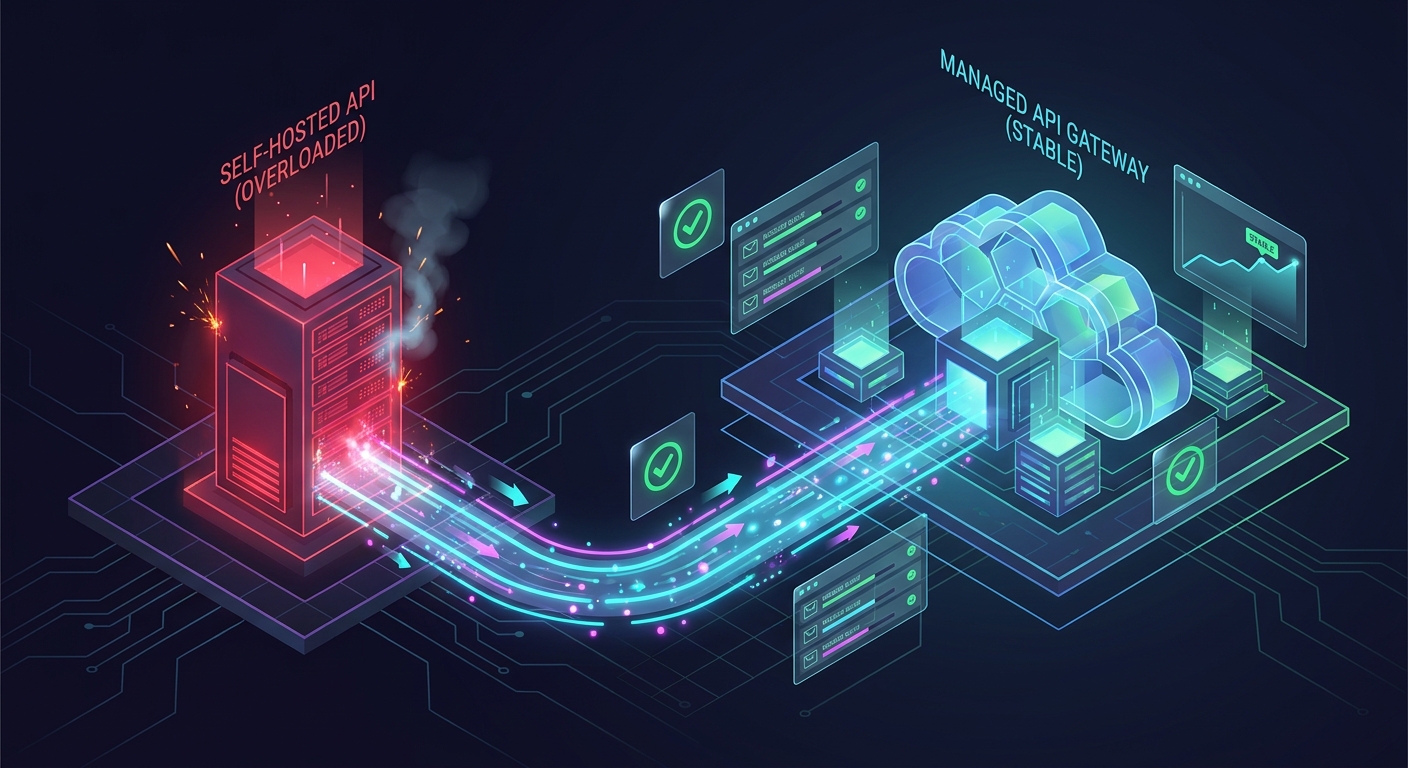
While self-hosted solutions offer deep customization, they also introduce significant hidden costs in the form of server provisioning, continuous monitoring, and emergency debugging during connection drops. Transitioning from a self-hosted environment to a fully managed WhatsApp REST API gateway is a critical architectural decision. This guide explores the technical trade-offs of self-hosting, outlines the critical infrastructure criteria for evaluating a managed alternative, and provides a comprehensive framework for migrating your SaaS or agency to a more resilient messaging architecture.
The Hidden Costs of Self-Hosted WhatsApp API Servers
Open-source WhatsApp APIs are powerful tools, but running them in a production environment requires a dedicated approach to infrastructure. When you deploy a self-hosted server, you are taking on the responsibility of managing the entire application lifecycle, from operating system updates to Node.js memory management. For high-growth SaaS platforms, this rapidly becomes a bottleneck.
Infrastructure and DevOps Overhead
Running a stable WhatsApp API server requires more than just deploying a Docker container to a basic virtual machine. To handle multiple client sessions (multi-tenancy) reliably, you must architect a highly available environment. This typically involves configuring load balancers, managing Redis for session state persistence, setting up MongoDB or PostgreSQL for message history, and continuously monitoring PM2 or Kubernetes pods for memory leaks. As headless browser instances or socket connections consume increasing amounts of RAM during high-volume message broadcasts, server costs can escalate unpredictably. The time your engineering team spends patching servers, updating dependencies, and restarting crashed instances is time taken away from developing core product features.
Session Instability and Connection Drops
One of the most persistent challenges with self-hosted WhatsApp API servers is maintaining stable sessions. WhatsApp's underlying architecture requires continuous, stateful connections. Network fluctuations, server resource exhaustion, or minor updates to the underlying protocol can cause sessions to disconnect. In a self-hosted environment, a dropped session often requires manual intervention or complex auto-restart scripts that don't always succeed. For marketing agencies managing hundreds of client accounts, a single server crash can result in thousands of undelivered messages, broken automated workflows, and severely impacted customer trust.
Evaluating the Best Evolution API Server Alternative: Key Decision Criteria
When you decide to migrate away from managing your own infrastructure, selecting the right managed gateway requires careful evaluation. The goal is not merely to find a cheaper host, but to upgrade to an architecture that guarantees reliability, scale, and ease of use. Here are the core technical criteria to consider when choosing the best Evolution API server alternative for your business.
1. Managed Multi-Session Architecture
If you are building a SaaS or a white-label agency platform, multi-tenancy is non-negotiable. Your chosen alternative must support seamless multi-session management without requiring you to spin up new servers or containers for every new client. A robust managed gateway abstracts the session layer entirely, allowing you to authenticate, monitor, and manage hundreds or thousands of distinct WhatsApp numbers through a single, unified RESTful interface. This decoupled approach ensures that an issue with one client's session does not impact the performance or stability of your entire messaging infrastructure.
2. Intelligent Message Queueing and Rate Limiting
High-volume marketing campaigns and SaaS notification systems often generate massive spikes in outbound messages. If an API attempts to push these messages to WhatsApp too quickly, it risks triggering spam filters or causing account bans. A premium server alternative must include intelligent, built-in message queueing. It should automatically handle rate limiting, pacing outbound messages to mimic natural human behavior, and implementing exponential backoff strategies for failed deliveries. This protects your clients' numbers and ensures higher overall deliverability rates.
3. Webhook Reliability and Retry Logic
In conversational AI and automated support workflows, inbound message processing is just as critical as outbound delivery. Your application relies on webhooks to receive real-time updates when a user replies. If your server experiences a momentary downtime or a network blip, a self-hosted API might simply drop the webhook payload, resulting in lost customer interactions. The ideal managed alternative will feature a fault-tolerant webhook architecture with automated retry logic. If your endpoint is temporarily unreachable, the gateway should queue the event and retry delivery, ensuring that your system maintains a perfect record of all conversational data.
How WasenderApi Solves the Infrastructure Bottleneck
For engineering teams seeking a scalable, maintenance-free messaging infrastructure, WasenderApi is designed to be the premier managed gateway. By entirely abstracting the complexities of WebSocket management, session persistence, and server scaling, WasenderApi allows SaaS platforms and agencies to treat WhatsApp messaging as a simple, reliable utility.
With WasenderApi, there are no servers to provision, no Docker containers to orchestrate, and no underlying libraries to manually update. The platform handles the heavy lifting of multi-session state management and intelligent message queueing natively. Developers can interact with the service through clean, predictable REST endpoints, focusing their efforts on building complex automation logic, AI chatbot integrations, and high-converting marketing workflows. For detailed endpoint structures and implementation examples, you can review the official API documentation.
Migration Strategy: Moving to a Managed WhatsApp Gateway
Migrating from a self-hosted Evolution API server to a managed gateway like WasenderApi is a straightforward process when executed methodically. By following a phased migration strategy, you can transition your active sessions and automated workflows without experiencing any downtime.
Phase 1: Payload Mapping and Abstraction
The first step in any API migration is mapping the data structures. Self-hosted APIs and managed gateways often use slightly different JSON payloads for sending messages and formatting webhooks. Begin by creating an abstraction layer within your application's codebase. Instead of hardcoding API calls directly into your business logic, route all messaging requests through a centralized internal service. This allows you to easily map your internal message objects to the specific payload requirements of the new managed gateway, ensuring a clean separation of concerns.
Phase 2: Webhook Redirection and Testing
Before migrating active client sessions, you must ensure that your application can properly ingest and process webhooks from the new provider. Set up a staging environment and connect a test WhatsApp number to your new managed gateway. Point the gateway's webhooks to your staging endpoint and run a comprehensive suite of tests. Verify that your system correctly parses inbound text messages, media files, delivery receipts, and status updates. Pay special attention to how the new gateway handles webhook retries and error reporting.
Phase 3: Gradual Session Migration
Once your payload mapping is complete and your webhooks are thoroughly tested, you can begin migrating production sessions. Avoid a "big bang" migration where all clients are moved simultaneously. Instead, adopt a gradual, rolling migration strategy. Select a small cohort of low-volume client accounts and transition their sessions to the new managed gateway. Monitor their message deliverability, webhook latency, and overall system performance closely. Once you have verified stability over a few days, gradually increase the migration velocity until all client accounts are successfully running on the new, scalable infrastructure.
Frequently Asked Questions (FAQ)
Why is migrating from a self-hosted API to a managed gateway recommended for scaling?
Migrating to a managed gateway eliminates the significant DevOps overhead associated with self-hosting. As message volumes and the number of active sessions grow, self-hosted servers require complex load balancing, memory management, and constant monitoring to prevent crashes. A managed gateway abstracts these infrastructure challenges, providing reliable, scalable REST endpoints so your team can focus on core product development.
What makes a managed service the best Evolution API server alternative?
The best alternative provides native multi-session management, built-in message queueing, automated rate limiting, and fault-tolerant webhook retry logic. It should remove the need for server maintenance while offering high availability and reliable message deliverability for SaaS and agency use cases.
How do I handle webhooks during the migration process?
During migration, you should create an abstraction layer in your codebase to map the new webhook payloads to your internal data structures. Test the new webhooks extensively in a staging environment using a test number before gradually migrating production sessions to ensure no inbound messages or delivery receipts are lost.
Will I lose active sessions when migrating to a new API gateway?
Migrating to a new API gateway requires re-authenticating the WhatsApp sessions (typically via scanning a new QR code or pairing code) on the new infrastructure. By using a phased migration strategy, you can coordinate this transition with your clients to ensure a smooth switchover with minimal disruption to their automated workflows.
Conclusion
Scaling a multi-tenant SaaS or agency platform requires infrastructure that can grow seamlessly alongside your customer base. While self-hosted open-source solutions provide an excellent starting point, the compounding costs of server maintenance, session instability, and DevOps troubleshooting eventually hinder growth. By evaluating and migrating to the best Evolution API server alternative, you transition from managing fragile WebSocket connections to leveraging a robust, reliable messaging utility. Choosing a managed gateway like WasenderApi empowers your engineering team to reclaim their time, ensuring high deliverability, scalable multi-session architecture, and a flawless communication experience for your users.